 SlingAgent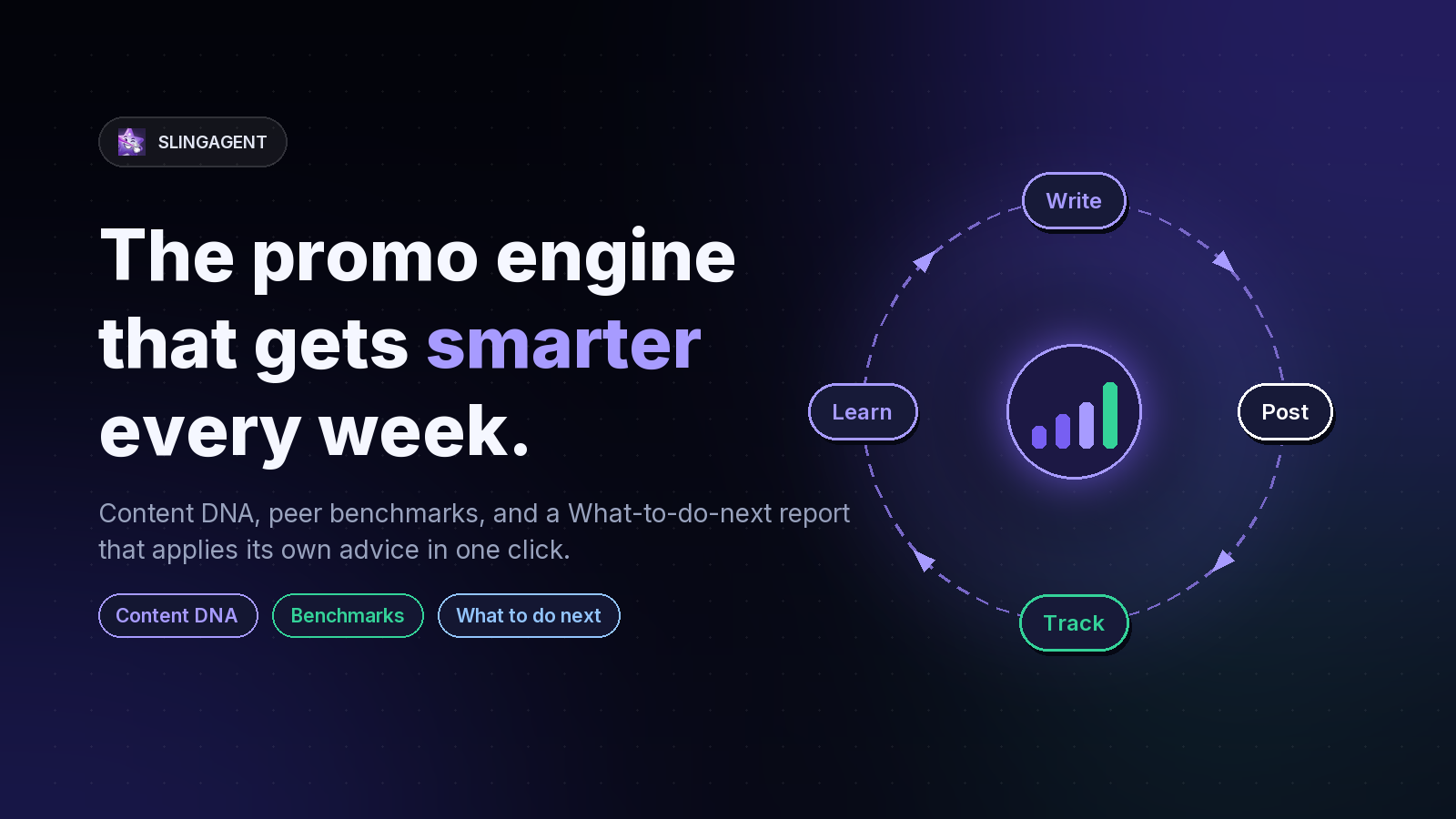
There is no shortage of tools that will post for you. Pick one, connect your accounts, fill a queue, and it will faithfully fire your words into the void on a timer. That's a pipe. Content goes in one end and comes out the other, and the pipe is exactly as smart on day 400 as it was on day 1.
SlingAgent is not a pipe. It's a loop.
Every promo it writes carries its own tracking link. Every click on that link is timestamped, geolocated, and attributed back to the exact post, platform, and hour that earned it. And then — this is the part almost nobody does — that data is fed back into the next thing it writes, the next hour it picks, and the next recommendation it puts in front of you. Write, post, track, learn, write better. The tool that promotes your work in month six is measurably better at it than the one you signed up for in month one, and it got that way from your results, not from a generic best-practices blog post.
That's the whole thesis. Everything below is how it's built.
Part 1: What SlingAgent actually does
Start with the input, because that's where the first difference shows up. Most tools want a post. SlingAgent wants a thing you're trying to grow.
Drop in any link — an affiliate offer, your book, your course, a client's landing page — and it pulls the title and image and starts writing. Or drop in a YouTube video, a blog post, or a podcast episode, and the repurposing engine turns one piece of content into a week of platform-tailored promos that drive people back to it. Connect an RSS feed or a sitemap and that happens on its own, forever, for everything you publish.
From there it fans out across X, LinkedIn, Instagram, Facebook, Threads, Bluesky, and Mastodon — with Pinterest and TikTok rolling out as their platform reviews finish — writing to each one's actual conventions rather than blasting identical text everywhere. It generates the images. It turns promos into vertical video for Reels, TikTok, and Shorts. It builds embeddable Ad Kit banners in newsletter, blog, and display sizes, each with its own tracking link and matching copy, so your email list becomes a measurable channel instead of a guess.
Then there's the long tail of features that exist because real promotion is messy:
- Share once — mint a one-off tracked link for any page right from the browser extension, attach an image, post it now or schedule it. Impromptu shares still land in your analytics instead of vanishing.
- Hashtag Groups — save the tag sets you reuse per topic, campaign, or client; drop a whole set in with one click. On Pro, SlingAgent reads the page and suggests tags you can bank into a group.
- Evergreen autopilot — flag a proven link and it re-promotes itself with fresh angles whenever its queue runs dry.
- Link-health monitoring — destinations get checked, so you're never promoting a dead page.
- Regional targeting — post at a region's local prime time, with per-region analytics.
- Buddies and the Promo Store — cross-promote with other creators, or adopt a community promo re-linked to your own affiliate tag.
Any one of these is a feature. Together they're a posture: SlingAgent assumes you have more things worth promoting than time to promote them, and that the gap is where your growth is leaking out.
Part 2: Reporting that answers questions instead of drawing pictures
Most analytics screens are a chart wall. They're honest — those really are your numbers — but they hand you the raw material and leave the thinking as an exercise for the reader. You end up staring at a line going down with absolutely no idea why.
SlingAgent ships roughly twenty distinct reports, and the interesting thing isn't the count, it's the question each one is built to close:
| Report | The question it answers |
|---|---|
| Engagement & CTR | Who actually saw the post, not just who clicked |
| Geography map | Where in the world your clicks come from, by country and region, per network |
| Portfolio | Which tag, content source, or link kind is carrying the rest |
| Link retention | Do links keep earning, or fade the moment you stop posting |
| Posting | Queued vs. posted vs. failed — and the click yield of each |
| Revenue timeline | Logged earnings against posting activity, over time |
| Network reach | What buddies and the Promo Store genuinely earned you |
| A/B learnings | Every test pooled — what keeps winning, and which winners you never reused |
| Benchmarks | Whether your numbers are good |
That last one deserves a note. A single account can compute its own click-through rate. Only a platform can tell you whether 2% is fine. Benchmarks compares you against genuinely comparable SlingAgent users — and does it under hard privacy rules baked into the code: only aggregates ever leave the module, never another user's name, handle, link, or value, and a metric is suppressed entirely unless at least five other qualified users are in the cohort, so nothing can be reverse-engineered from a group of two. The cohort is also active users, not everyone, because comparing a working account to a shelf of empty ones would flatter you into ignoring a real problem.
There's also an anomaly engine running a fixed 7-day vs. previous-7-day comparison for every account, free plans included. Its job isn't spotting that clicks dropped — you can see that on the chart. Its job is correlating the drop with the cause the system already recorded: a platform whose posts started failing, a link that went broken, an account whose token expired, a queue that ran dry. That's the difference between a chart and an alert.
Part 3: Content DNA — what your winning posts have in common
Everywhere else in analytics, you count clicks by where and when. Content DNA asks a completely different question: what was the copy itself like?
It breaks every published promo into observable facets — deliberately simple, deterministic checks, no AI and no per-post cost, so the descriptions are identical run to run and can actually be trusted:
- Length — short (under 100 chars), medium, long, very long
- Opening — did the first sentence ask a question, or tell you something
- Emoji — present or not
- Call to action — matched against a phrase list ("grab", "check it out", "link in bio", "don't miss"…)
- Hashtags — none, 1–3, 4–7, 8 or more
- Media — image, video, or text only
- Image source — your product image, or AI-generated
Then it scores each bucket by lift: average clicks for posts in that bucket relative to your account-wide average. A lift of 1.4 means posts like this did 40% better than your typical post. It layers hashtag-level rows and per-platform fit on top, and where impressions exist, it reach-adjusts the result.
What makes this report trustworthy is what it refuses to say. A bucket needs at least three posted promos before it appears. The whole report stays quiet until you have eight. A dimension only declares a winner when the leading bucket beats the runner-up by 20% or more and both clear the sample gate — otherwise it says it's a wash, which early on it usually is. And it's explicit that this is descriptive, not causal: a lift means "posts like this did better," not "do this and you'll do better."
That restraint is exactly why the output is worth acting on. Every marketing tool on earth will happily tell you that emoji increase engagement. Content DNA tells you that your audience clicks 60% more on posts under 100 characters that open with a question and carry no hashtags at all — or that for you, none of it matters and the only thing moving the needle is which platform you posted to. Both answers are useful. Only one of them is available from a blog post about best practices.
Part 4: What to do next — advice that does the work
The most valuable report in SlingAgent is also the shortest, and it exists because of a specific frustration. Ordinary tips are good sentences that end with you going and finding the screen and making the change. Most people never do. The insight evaporates.
So every entry in What to do next carries three things a tip doesn't:
- Evidence. One line explaining why we're saying it — "0.31% click-through vs. your 1.8% median", "no clicks in 30 days despite 412 all-time", "from 47 published posts".
- A destination or an operation. Not "consider adjusting your schedule," but a button.
- Priority. Anomalies with a correlated cause sort to the top; pattern insights sort to the bottom.
And the operations are real. One click will: reuse the winning A/B variant so every future promo for that link echoes the copy that already earned clicks; turn on evergreen recycling for a proven link that's gone quiet; switch a fixed schedule to smart scheduling now that there's enough history to learn from; shift your default posting hours to just ahead of your observed click peak; or pause a link that has published twenty posts and earned nothing, so it stops spending your monthly generations and your audience's patience.
Two samples of what it surfaces, in its own voice:
A post is converting far above your average but barely reached anyone. "…" earned 34 clicks from only 1,200 impressions on LinkedIn. The creative works — it just needs distribution.
A widely-seen post isn't earning clicks. "…" reached 41,000 people on X but only earned 6 clicks. The audience is there; the copy or the call to action isn't landing.
Those are two opposite problems that look identical on a clicks chart. Separating them is the difference between boosting a winner and rewriting a dud.
Dismissals stick, too — recommendation IDs are derived from content rather than row IDs, so waving something off keeps it from resurfacing on the next recompute. And when you apply a recommendation, that's a signal: it's how the system learns which advice was worth giving.
Part 5: The five loops that make it smarter
Here's the part that compounds. SlingAgent runs five separate feedback loops, each closing on a different timescale.
1. The writer learns your winners. Before generating copy, the system pulls your best-performing platform and the actual text of your top-performing post to date, and instructs the model to echo what makes it work — the hook, the angle, the energy — without copying it verbatim. Your best post becomes the reference for your next one. Permanently.
2. Scheduling learns your audience. Smart scheduling reads 60 days of click history to find when your links genuinely get clicked, then posts one hour before the peak so the content is already live when people show up. It requires at least 20 clicks of signal and falls back to your configured hours below that — it will not guess at you.
3. A/B tests compound instead of evaporating. Variants share a group but each gets its own tracking link, so clicks attribute cleanly. A winner is only called after at least 10 clicks, because a lead on 3 clicks is noise. Then the A/B learnings report pools every test you've ever run to find what keeps winning — and flags the winners you never fed back into rotation.
4. Content DNA feeds the recommendations. Your facet takeaways don't just sit on their own page; they're piped directly into the recommendation engine as insights, sample size attached.
5. The benchmarks sharpen as the platform grows. Your cohort comparison improves with every active user who joins — a learning loop no single-account tool can ever have, and one that pays out to everyone at once.
Notice what all five have in common: a threshold. Twenty clicks. Ten clicks. Three posts per bucket, eight per report. Five peers minimum. A 20% margin before declaring a winner. Building an engine that learns is easy; the hard part is building one that knows when it hasn't learned anything yet and has the discipline to stay quiet. Confidently wrong advice, applied automatically, is worse than no advice at all — so every loop above is gated, and every gate degrades to "not enough data" instead of to a guess.
Why this matters
The schedulers aren't wrong. They're finished. They solved "posting is tedious" and stopped there, and that problem was worth solving in 2014.
The problem now is different. You're publishing more than ever, across more networks than ever, and you have almost no idea which of it is working. The feedback loop between what you wrote and what it earned is broken at nearly every step — one tool for posting, another for links, another for analytics, and nothing in the chain that closes the circle back to the writing.
SlingAgent closes it. It writes the promo, mints the link, picks the hour, publishes the post, catches the click, correlates the drop, names the pattern, and hands you the next move with a button attached. Then it does it again next week, knowing more.
That isn't a better scheduler. It's a different category of thing — a promotion engine with a memory. And the strongest argument for it is one you can't see in a feature list, only in a calendar: it is worth more to you in November than it was in August, and you didn't have to do anything to make that true except keep using it.
Start free at slingagent.com — every new account starts with 14 days of Pro, no card required.